Revision
10 min readA Qur’an revision schedule you can adapt
Plan recent and older Qur’an revision around your week, with an example timetable, a missed-day adjustment and a printable planner to discuss with your teacher.

In this guide
You sit down to revise and spend the first few minutes deciding where to begin. Yesterday’s lesson needs another attempt, an older surah has become hesitant, and there are new ayat you hoped to learn. By the time you choose, part of your practice time has gone.
A written revision plan can make that moment easier. You know which passage to return to, what needs checking and where the rest of your memorisation fits later in the week.
Begin with the Qur’an you already know and the time you can usually give it. Then build a week you can discuss with your teacher and change when your recitation needs more care.
Start by hearing what needs attention
Write down the surahs or ayah ranges you have memorised. Include scattered passages separately so they are easy to find again. If you use page numbers, keep to the same mushaf edition when recording them.
Next, recite some of that work from memory. Notice where you continue comfortably, where you hesitate and where you need someone to give you the next word. If you are unsure whether you recited accurately, note that for your teacher to hear.
An older surah may come back more easily than last week’s lesson. Let the recitation help you choose what needs attention. The date you learned a passage gives you only part of the picture.
You might write, “I needed a prompt before the final ayah,” rather than “This surah is weak.” That gives you a particular place to revisit and a clear question to take to your lesson.
Give three kinds of work a place
When you start putting passages into the week, separate them into three groups:
| Work | What belongs here | What to write in the plan |
|---|---|---|
| New lesson | A passage you are currently learning for the first time | The exact assignment and when your teacher will hear it |
| Recent revision | Passages you have learned recently and are still consolidating | The passages to revisit, including corrections from recent lessons |
| Older revision | Memorisation from earlier in your learning | Manageable portions in a rotation that includes all the older work |
Ask your teacher which passages belong in your recent revision and when they should move into the older rotation. The boundaries can change as your learning grows.
Divide older work into portions that fit a normal sitting. If one portion takes much longer than the others, split it or give it more space. Write the surah and ayah range beside each label so “portion C” means something when you return to it.
Keep a small note of recurring difficulties alongside these groups. A difficult join belongs to a passage you will recite again; practising it separately should lead back into that passage.
Protect revision time before adding more
It is tempting to fill the available time with new ayat and leave revision for whatever remains. As the amount you know grows, earlier passages can then disappear from the week.
The Prophet ﷺ said:
تَعَاهَدُوا الْقُرْآنَ فَوَالَّذِي نَفْسِي بِيَدِهِ لَهُوَ أَشَدُّ تَفَصِّيًا مِنَ الإِبِلِ فِي عُقُلِهَا
Meaning: “Keep attending to the Qur’an. By the One in Whose hand is my soul, it escapes more readily than camels from their restraints.”
Sahih al-Bukhari 5033. The Hifz Academy’s English rendering of the meaning of the complete Prophetic statement.
This reminder gives continued care a place in learning the Qur’an. Even a passage that once felt settled needs returning to. A slipping join tells you where to give attention; it does not tell you the state of your faith.
Reserve time for the revision your teacher has assigned, including corrections. Then discuss how much new learning fits alongside it. Some weeks may need smaller new portions or a stronger focus on revision.
An example week to change with your teacher
Suppose you have divided your older memorisation into six manageable portions, labelled A to F. You also have recent work to revisit and a new assignment on some days. The table below shows how these might share the week.
All minute figures are examples of time set aside, including correction and planning. They do not predict how quickly you will finish a passage. Replace the portions, days and timings with what suits your recitation and your teacher’s guidance.
| Day | New lesson | Recent revision | Older revision and other work | Example time |
|---|---|---|---|---|
| Monday | Assigned new passage, 5 minutes | Assigned recent work, 8 minutes | Portion A, 12 minutes; corrections, 5 minutes | 30 minutes |
| Tuesday | No new passage in this example | Assigned recent work, 10 minutes | Portion B, 15 minutes; corrections, 5 minutes | 30 minutes |
| Wednesday | Assigned new passage, 5 minutes | Assigned recent work, 8 minutes | Portion C, 12 minutes; corrections, 5 minutes | 30 minutes |
| Thursday | No new passage in this example | Assigned recent work, 5 minutes | Portion D, 10 minutes; corrections, 5 minutes | 20 minutes |
| Friday | No new passage in this example | Assigned recent work, 10 minutes | Portion E, 15 minutes; corrections, 5 minutes | 30 minutes |
| Saturday | Assigned new passage, 5 minutes | Assigned recent work, 8 minutes | Portion F, 12 minutes; corrections, 5 minutes | 30 minutes |
| Sunday | No new passage in this example | Agreed recent passage, 5 minutes | Agreed older passage, 5 minutes; review next week’s plan, 5 minutes | 15 minutes |
Follow your actual lesson assignment if it differs from this example. A new passage may need more time than the space shown here. If the work does not fit, adjust the amount with your teacher rather than rushing to finish every cell.
The A to F rotation makes all six older portions visible in this example. If you know more or less Qur’an, the number and size of your portions will differ. Your teacher can help decide when each should return. This table does not establish a required seven-day cycle for every learner.
You can use the weekly practice planner to write your own passages. It has spaces for new memorisation, recent revision, older revision and anything that needs another attempt. It is a printable page, so fill it in by hand after printing or saving it as a PDF. For a digital plan you can edit, copy the table into a document or your usual notes app.
When one join keeps slipping
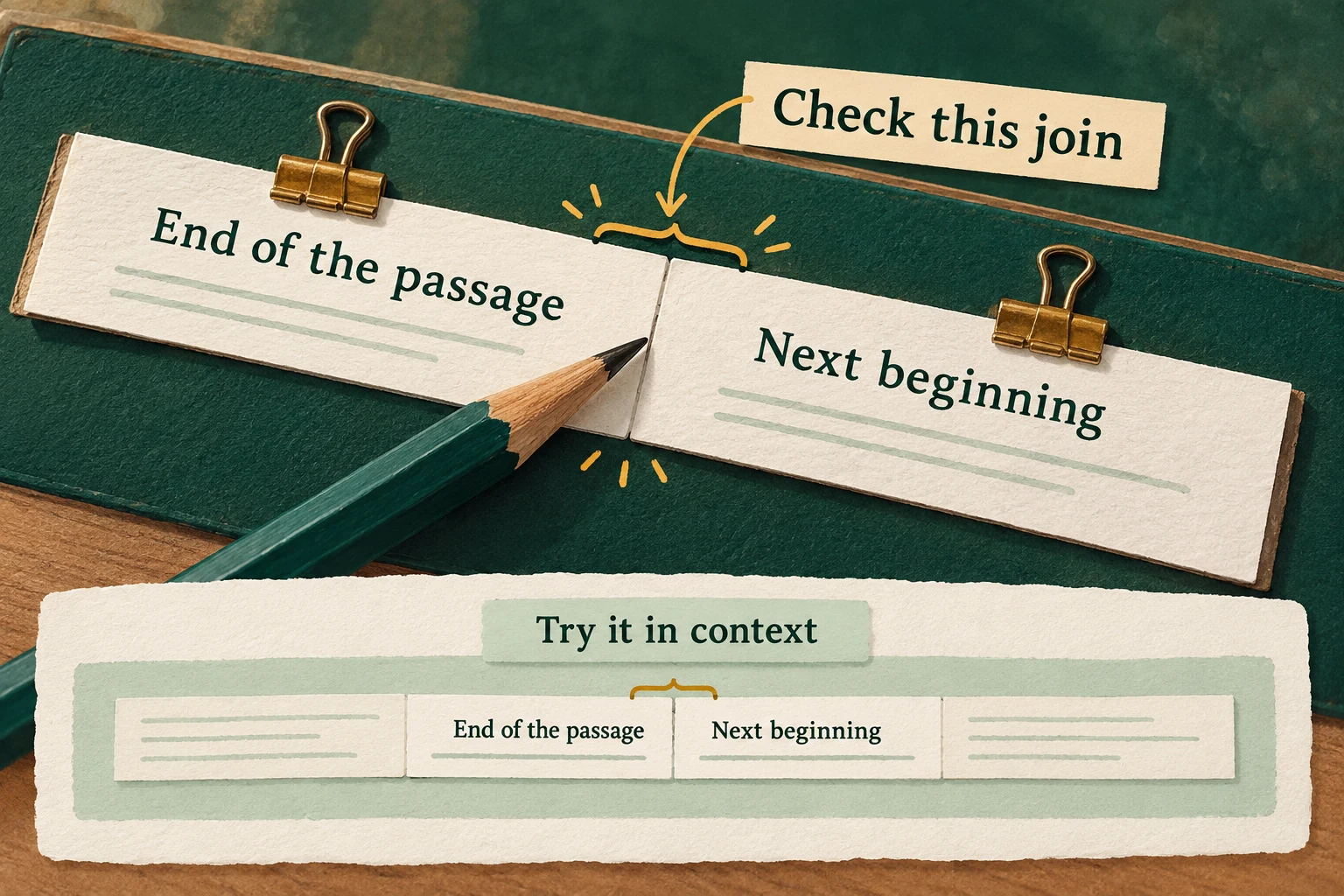
Perhaps portion C goes smoothly until the same transition you hesitated over last time. Make a note of the exact place. Check the correct wording and pronunciation, and ask your teacher if you are uncertain.
Practise the end of the first part with the beginning of the next. Then recite the join within a longer stretch of the passage. On your next attempt, notice whether you can continue without the same prompt.
In His instruction to the Prophet ﷺ about night prayer, Allah says:
وَرَتِّلِ الْقُرْآنَ تَرْتِيلًا
“and recite the Quran ˹properly˺ in a measured way.”
Qur’an 73:4, recitation clause excerpt. Translation: Dr. Mustafa Khattab, The Clear Quran.
Keep that care for recitation in view when deciding the workload. The ayah does not prescribe the timetable above. If completing your planned portion means rushing words or skipping corrections, take that difficulty to your teacher and discuss a smaller amount.
If you miss Tuesday, make a place for its passage
Suppose Tuesday’s practice does not happen. On Wednesday, you still have the time you originally planned, so doing both full sessions may be unrealistic.
Start by checking what your teacher needs to hear next and which passage needs attention. You might move Tuesday’s portion B into Wednesday’s older-revision space, then give C a named place later in the week. Discuss whether the new assignment should be smaller or postponed while you make room.
Write the change into the plan. If C has moved to Thursday, decide where D will go too. Continue the adjustment until every displaced portion has a place, even if the rotation runs into the following week. Ask your teacher about the priorities and intervals when you cannot fit them comfortably.
A practical reminder
Before you close the planner, write where the missed passage will return. An arrow needs a destination you can find tomorrow.
If Tuesday is missed repeatedly, look at that part of the week. A different time or a smaller assignment may be easier to keep. Our daily Qur’an routine guide can help you think through that choice.

Use the end of the week to choose the next one
Look back at the passages you attempted. Which could you recite without help? Which still needed a prompt? Did a correction become easier to recall, and did every older portion get its planned turn?
Compare the time you set aside with the time the work took. If several sessions overran, the portions may need to be smaller. If older revision keeps being pushed aside for new learning, discuss the balance before adding more ayat.
Keep a short note for your next lesson. “I reached all six portions, but B and E still needed prompts” is more useful than a row of ticks that hides those difficulties.
You can also return to the meaning of familiar ayat through a reliable translation or an explanation your teacher recommends. Leave yourself room to attend to Allah’s words while caring for accurate recitation.
If you are still finding a way to learn your new assignment, our guide to memorising the Qur’an walks through a manageable passage and recall practice. For now, write down the passage you will return to tomorrow and the question you want your teacher to hear.
May Allah help you care for what you have learned and benefit from His words. If you would like to understand the academy’s approach to lessons and practice, you can see how guided learning works.
Questions about a Qur’an revision schedule
How much should I revise each day?
Choose the amount with your teacher after they hear your recitation. What you have memorised, the prompts you need and the time available all affect the workload. Leave time to check and correct the difficult parts.
Should I revise before learning new ayat?
Reserve revision time before deciding how much new learning fits. Follow your teacher’s guidance about the order of the session. If earlier work needs considerable attention, discuss reducing new learning for a while.
Can I use this plan if I know only a few short surahs?
Yes, you can use the same columns with smaller amounts. You may have fewer older portions than A to F. Write down your own surahs and agree with your teacher how often to return to each.
Do I need an app to track revision?
A notebook or printed planner can be enough to find the passage and remember the correction. An app may help with reminders, but it cannot establish that your recitation was accurate or replace someone listening.